Feature Interview | Hong Kong Enterprise Builds Satellite Constellation to Expand the Space Economy
The nation’s “15th Five-Year Plan” has incorporated the building of a strong aerospace nation into its modern industrial strategy, officially ushering in a data-centric “New Space Era.” The HKSAR Government has also positioned the space economy as an emerging direction, attracting startups to seize opportunities and promoting the transition of satellite technology from academic research to practical applications, empowering industries and driving innovation upgrades.
As a Hong Kong-rooted climate tech startup, Stellerus Cloud Intelligence was honored to accept an exclusive interview with Hong Kong Wen Wei Po at this critical juncture, sharing the company’s exploration and practice in artificial intelligence meteorology and satellite technology. We believe that technology is not only a driving force for industrial upgrading, but also an important cornerstone in addressing climate change, safeguarding urban safety, and advancing sustainable development.
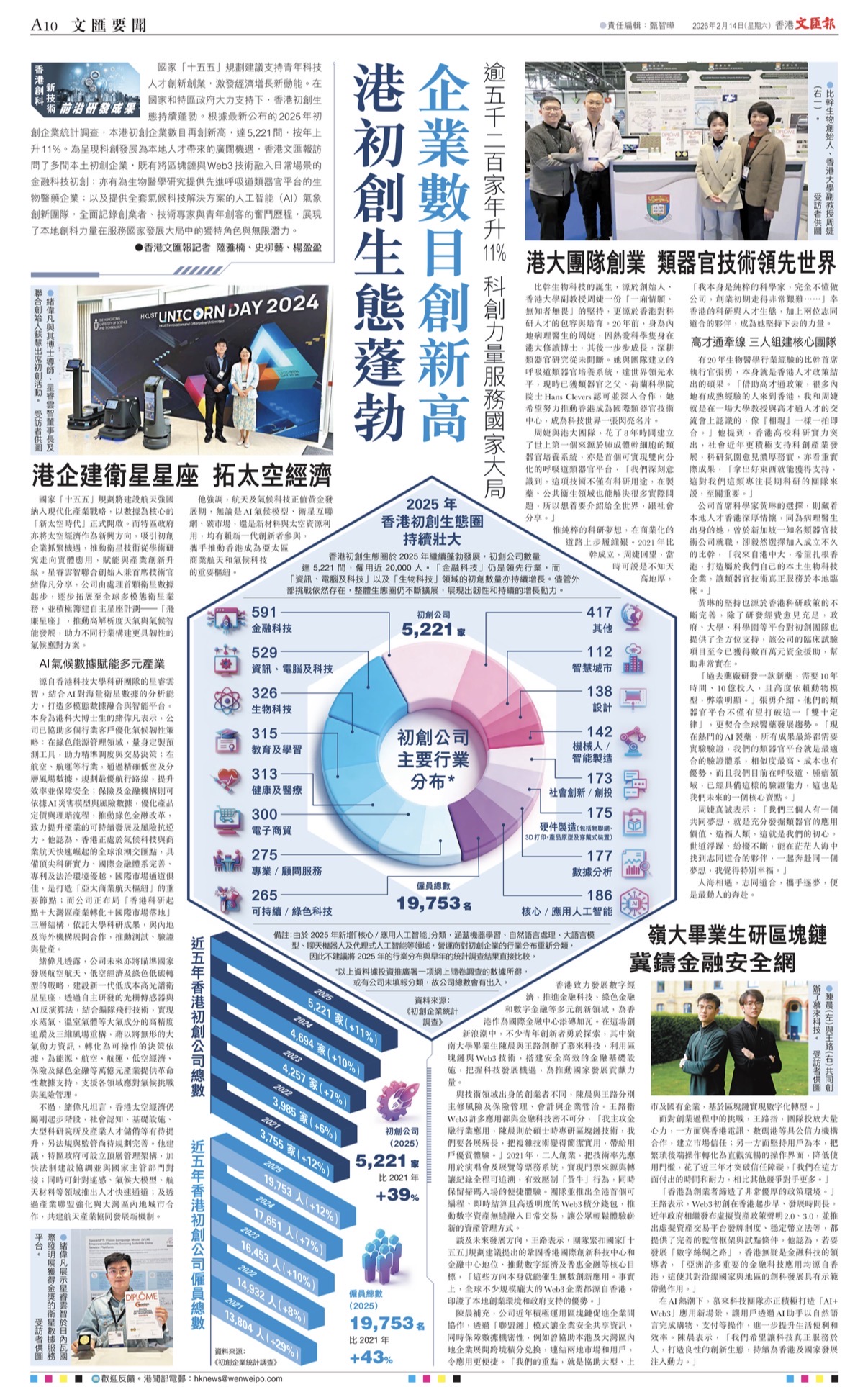
Wen Wei Po published page layout
Co-founder and Chief Technology Officer of Stellerus Technology Limited, Xu Weifan stated that the company started by processing data from its first satellite, gradually expanding to global multimodal satellite operations, and is actively building its own “Feilian Constellation” to promote high-resolution weather and climate intelligence development, providing more resilient climate response solutions for various industries.
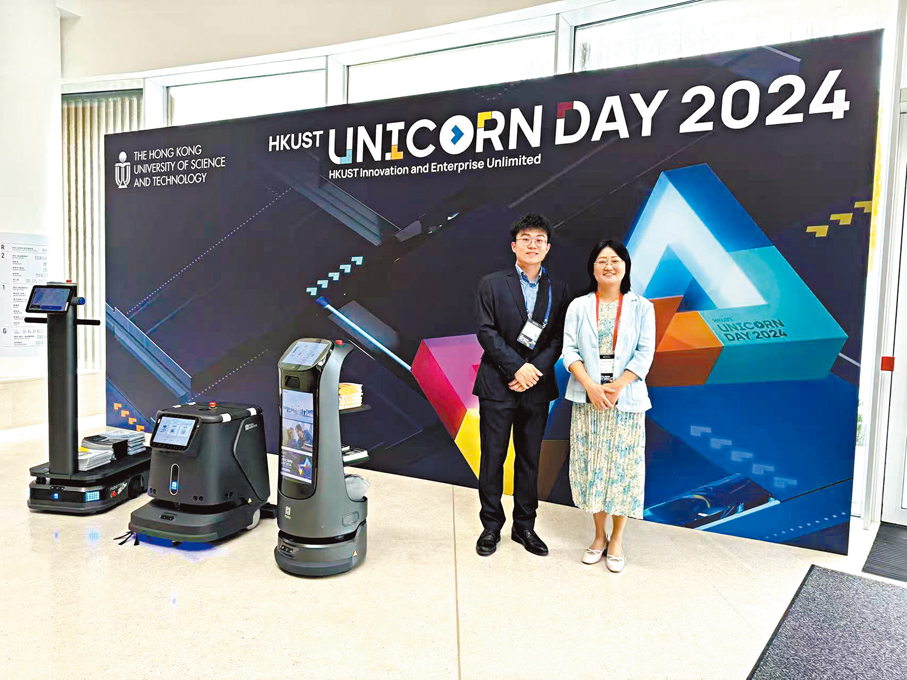
Xu Weifan (first from right) attended a startup event together with Stellerus’ Chairman and Co-founder Su Hui.
Originating from a research team at the Hong Kong University of Science and Technology, Stellarus integrates artificial intelligence with massive satellite data analysis capabilities to build a multimodal data fusion and intelligent platform. It has been widely applied in green energy management, aviation and maritime route optimization, insurance risk modeling, and green finance decision-making, helping industries enhance efficiency and risk management capabilities. The company is also implementing a three-tier development framework of “Hong Kong research + Greater Bay Area industrial transformation + international market deployment” to accelerate the large-scale application of research outcomes.
Looking ahead, Xu Weifan pointed out that the company will align with national aerospace, low-altitude economy, and green low-carbon transition strategies to build a new-generation, low-cost hyperspectral satellite constellation. Through proprietary grating sensors and AI inversion algorithms, it aims to achieve precise tracking of atmospheric components and three-dimensional wind field reconstruction, providing key data support for trillion-dollar industries such as energy, transportation, insurance, and finance.
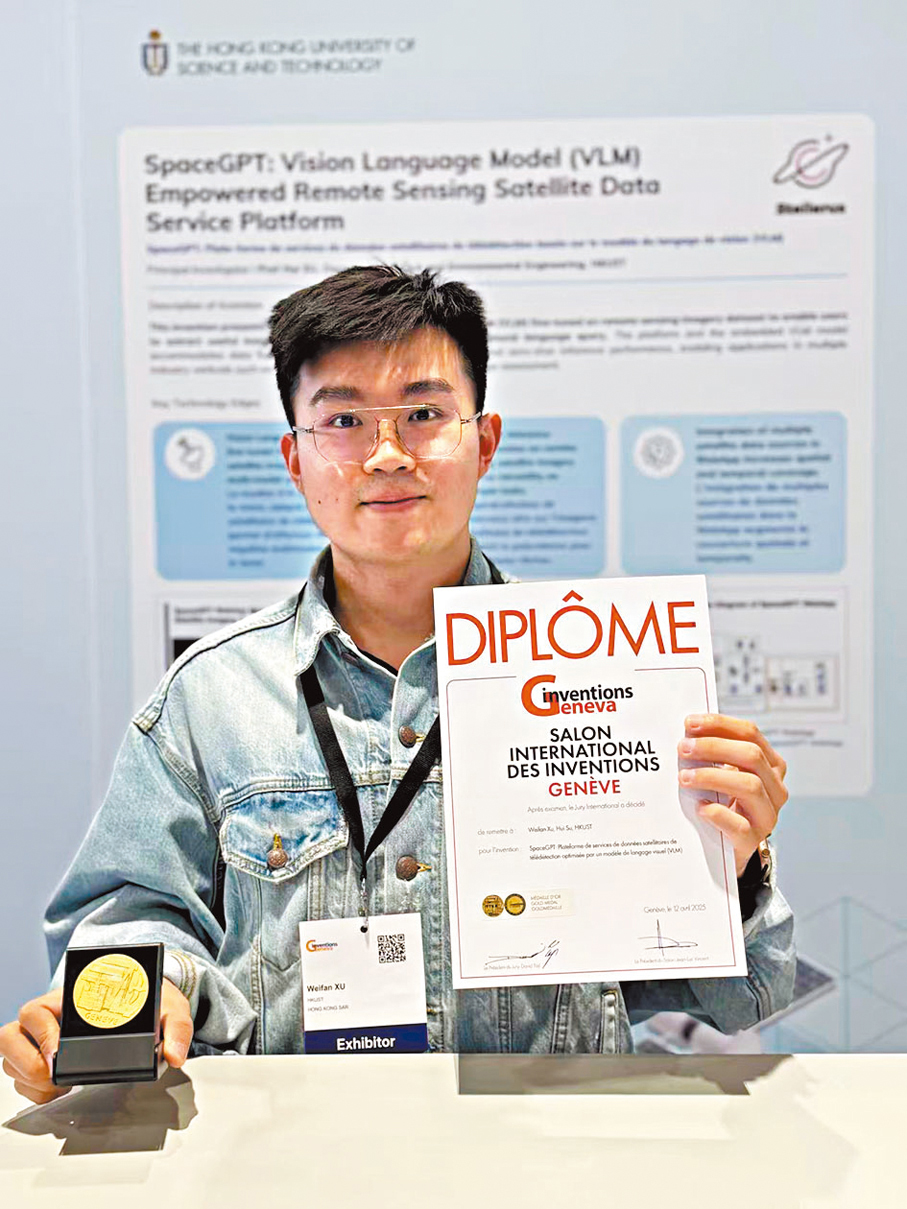
Xu Weifan showcases Stellerus’ Gold Award at the Geneva International Exhibition of Inventions
He frankly stated that Hong Kong’s space economy is still at an early stage and suggested strengthening top-level governance structures and regulatory frameworks, establishing dedicated talent pathways, deepening collaborative development with the Greater Bay Area, and promoting Hong Kong as an important commercial aerospace and climate technology hub in the Asia-Pacific region. He pointed out that aerospace and climate technology are entering a critical development window and that it is necessary to unite the power of a new generation of innovative talents to jointly build Hong Kong into a core hub for commercial aerospace and climate technology in the Asia-Pacific region.
Source: Hong Kong Wen Wei Po
Online link: https://bit.ly/4aNheKk