Feature Interview | Professor Hui Su: After Leaving NASA, She Sent "Sky Eye" to "Tiangong" in Hong Kong
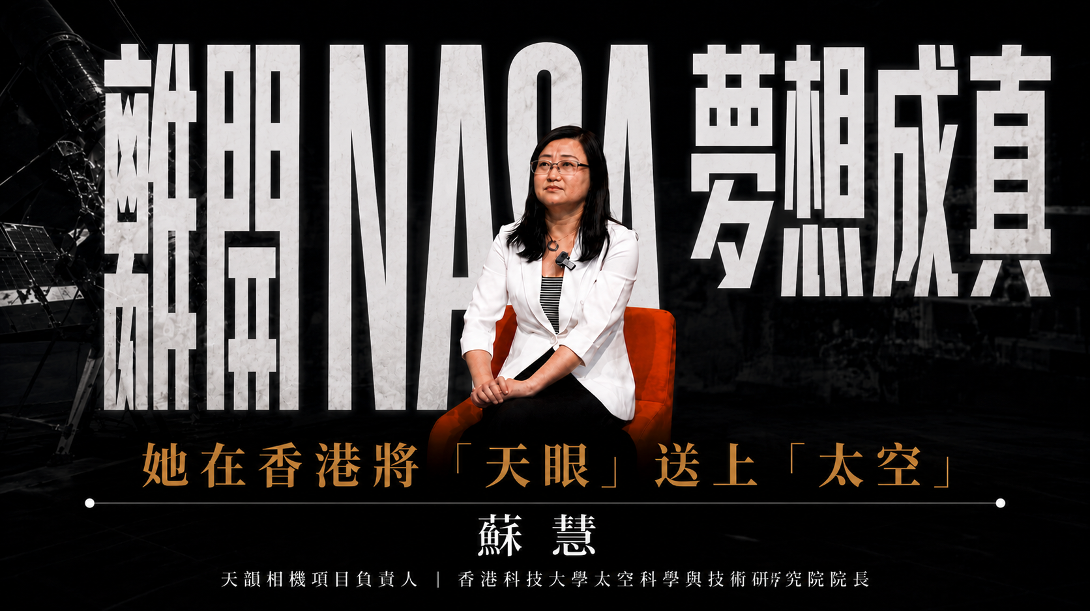
On July 24, South conducted an exclusive interview with Professor Hui Su, Chair Professor of the Department of Civil and Environmental Engineering at The Hong Kong University of Science and Technology, "Global STEM Scholar", and Founder & Chairwoman of Stellerus Tech. The interview delved into her scientific research journey from the National Aeronautics and Space Administration (NASA) to HKUST, as well as the story behind leading her team to successfully develop the "MUSICO" (Multi-Spectral Imaging Carbon Observatory) and bringing Hong Kong's scientific research payload onto the China Space Station.
During the interview, Professor Hui Su shared her original aspirations in scientific research and her profound thoughts on China's technological innovation and development. On July 23, the Fields Medal was announced, and Chinese mathematicians Wang Hong and Deng Yu won the honor, becoming the first batch of Chinese scholars to receive the Fields Medal. Professor Hui Su immediately forwarded relevant reports on her WeChat Moments and wrote the phrase "Honored to share this pride", expressing her heartfelt pride in Chinese scientific research talent stepping onto the world stage.
In 1993, Hui Su went to the United States for further studies and subsequently joined NASA, where she engaged in long-term research on atmospheric science, climate change, and satellite remote sensing over a 17-year scientific career. In 2022, she resolutely gave up her stable research career in the United States to join HKUST, hoping to leverage Hong Kong's internationalized scientific research platform to carry out more impactful research work.
In 2026, led by HKUST with Professor Hui Su as one of the project leaders, "MUSICO" was successfully installed on the China Space Station and officially put into operation. This is the world's first lightweight, high-resolution, high-precision synergistic observatory for carbon dioxide and methane emission point sources. It is also the first scientific research payload led and developed by a Hong Kong research team to enter the China Space Station, marking an important milestone in Hong Kong's aerospace research.
It took two years from the project initiation to the successful launch of "MUSICO". To catch the Tianzhou-10 launch window, the team needed to complete the design, processing, testing, and verification of high-precision instruments within an extremely short period, overcoming multiple technical hurdles including core optical components. Teams from HKUST and the Changchun Institute of Optics, Fine Mechanics and Physics, Chinese Academy of Sciences worked day and night, ultimately completing the mission smoothly. Recalling the development process, Professor Hui Su admitted: "It really felt like going to war back then—we absolutely could not lose."
Speaking on the reasons for returning to Hong Kong, Professor Hui Su stated that during her time at NASA, she always hoped to lead groundbreaking aerospace research projects, but was unable to do so due to limitations in the research environment and resources. In recent years, Hong Kong has actively promoted innovation and technology development. Combined with the Guangdong-Hong Kong-Macao Greater Bay Area's comprehensive manufacturing capabilities, supply chain system, and vast application scenarios, this allowed her to see new opportunities for growth and led to the birth of the "MUSICO" project.
Currently, "MUSICO" has commenced in-orbit operations on the China Space Station. In the future, it will continuously monitor global greenhouse gas emissions, providing high-precision data support for carbon peaking, carbon neutrality, and global climate change research.
Looking ahead, Professor Hui Su hopes to take the important breakthroughs in Hong Kong's aerospace technology in 2026 as a new starting point to further refine Hong Kong's aerospace technology development plan, strengthen synergy among scientific research, industry, talent, and policy, push Hong Kong to transition from an aerospace technology participant to a leader, participate more deeply in the nation's aerospace endeavors, and contribute more Hong Kong wisdom and Chinese strength to global green and sustainable development.