Company News | Professor Hui Su Advises on Hong Kong's Five-Year Plan, Advocating for the Development of the Space Economy
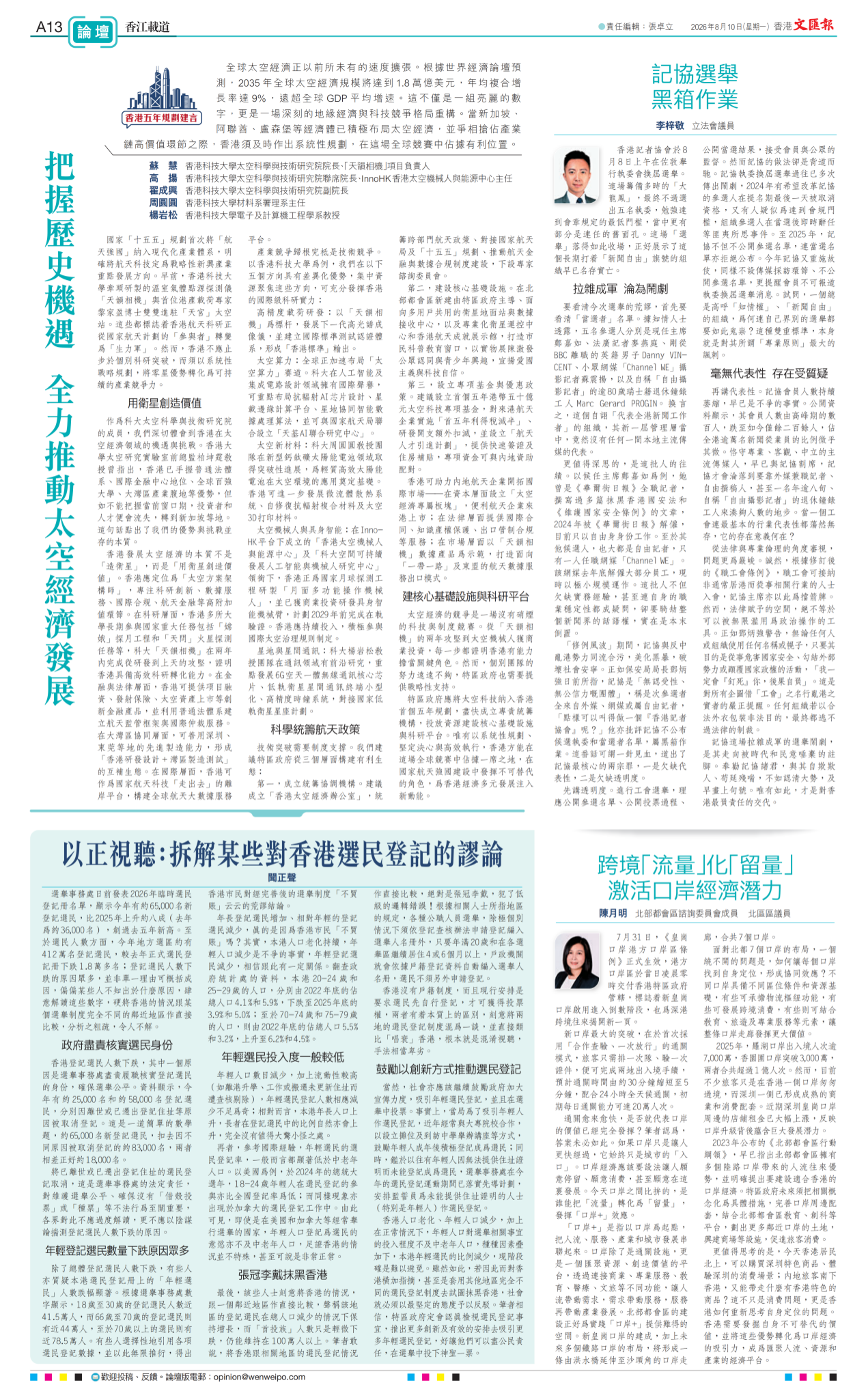
Professor Hui Su, Chair Professor of the Department of Civil and Environmental Engineering, Director of the Institute for Space Science and Technology at The Hong Kong University of Science and Technology (HKUST), "Global STEM Scholar", and Founder & Chairwoman of Stellerus Tech, together with several professors from HKUST's Institute for Space Science and Technology and related departments, submitted proposals to promote the development of the space economy under Hong Kong's Five-Year Plan, which were published in Wen Wei Po.
The proposal points out that the global space economy is expanding at an unprecedented pace. According to forecasts by the World Economic Forum, the global space economy will reach US$1.8 trillion by 2035, with a compound annual growth rate of 9%, far exceeding the average growth rate of global GDP. As economies such as Singapore, the United Arab Emirates, and Luxembourg actively position themselves in the space economy and compete for high-value segments of the industrial chain, Hong Kong should seize this historical opportunity to make systematic planning early and secure a favorable position in the global space economy competition.
The proposal notes that the nation's 15th Five-Year Plan incorporates building a "space power" into the modern industrial system for the first time, explicitly listing space technology as a key direction for strategic emerging industries, which provides a major opportunity for Hong Kong to develop its space economy. In recent years, Hong Kong's space research achievements have achieved continuous breakthroughs. The greenhouse gas point-source detector "MUSICO" (Multi-Spectral Imaging Carbon Observatory), led and developed by HKUST, successfully entered the national "Tiangong" space station. Dr. Lai Ka-ying, Hong Kong's first payload specialist, also participated in national space missions, marking Hong Kong's gradual transition from a "participant" to an important "vital force" in national space programs. However, Hong Kong should not stop at individual research achievements, but should convert research advantages into sustainable industrial competitiveness through top-level design and systematic policy planning.
Creating Value Through Satellites
The proposal emphasizes that the core of Hong Kong's development of the space economy is not merely "building satellites", but "creating value through satellites". Hong Kong should position itself as a "Space Solution Architect", giving full play to its unique strengths in scientific research innovation, international finance and law, and industrial synergy in the Guangdong-Hong Kong-Macao Greater Bay Area. It should focus on high value-added sectors such as the commercialization of research outcomes, space data services, space finance, international compliance, and commercial applications, utilizing Hong Kong as an offshore platform for national space technology to "go global" and establishing a global commercial space big data service platform.
In terms of industrial layout, taking HKUST as an example, resources should be concentrated on developing five core technologies: high-precision payload R&D, space computing power, new space materials, space robotics and embodied intelligence, and satellite-to-ground and inter-satellite communications. Focusing resources on these directions can fully leverage Hong Kong's world-class scientific research capabilities. Regarding high-precision payload R&D, the proposal suggests using "MUSICO" as a benchmark to develop next-generation hyperspectral imagers and establish an international testing and certification system to export a "Hong Kong Standard".
Scientific Coordination of Aerospace Policies
At the policy level, technological breakthroughs require institutional support. The proposal suggests scientifically coordinating aerospace policies and building a favorable ecosystem from three levels: First, establish the "Hong Kong Space Economy Office" to interface with the China National Space Administration and the 15th Five-Year Plan; second, build core infrastructure, including satellite ground stations, data reception centers, specialized satellite operation centers, and the Hong Kong Aerospace Achievement Exhibition Hall; third, establish a dedicated fund and preferential policies, proposing a HK$5 billion Space Technology Special Fund for the first five years, alongside tax incentives such as "halving profits tax for the first five years" for space enterprises, research subsidies, the "Aerospace Talent Admission Scheme", fast-track visas, and housing subsidies to attract more international enterprises, research institutions, and high-end talent to settle in Hong Kong.
Furthermore, Hong Kong can assist Mainland space enterprises in expanding into international markets—proposing to establish a "Dedicated Space Economy Board" at the capital level to facilitate space enterprises listing in Hong Kong; providing services for international contracts, intellectual property protection, and export control compliance at the legal level; and using "MUSICO" data products as a demonstration at the market level to create a space data service export model tailored for the Belt and Road Initiative and ASEAN.
Building Core Infrastructure and Scientific Research Platforms
Overall, the proposal concludes that the space economy has become a new height in global technological and industrial competition. From the two-year intensive campaign of "MUSICO" to commercial investments secured for space robotics, every step proves that Hong Kong has the capability to play a crucial role. Hong Kong should take the opportunity of its first five-year plan to establish a dedicated coordinating body as soon as possible and commit resources to building core infrastructure and research platforms. Only with systematic planning, firm determination, and efficient execution can Hong Kong secure a position in this global race, play an irreplaceable role in building the nation into a space power, and inject new momentum into the diversified development of Hong Kong's economy.